


Milwaukee Metal Fest Paired With ACID BATH Took Milwaukee By Storm Friday Night.
Friday, 6/5/2026, The Rave/Eagles Club, Milwaukee, Wisconsin

Summer is starting, and for fans of all things heavy, they know exactly what that means: Milwaukee Metal Fest. The iconic metal festival hosted in the Cream City is known for its packed lineup from all spans of metal genres in addition to hosting local names and iconic bands. For an early start to the festival season, Friday’s lineup had exactly what metal fans were looking for.
Founded in 1987 by heavy metal band manager and concert promoter Jack Koshnick, Milwaukee Metal Fest had filled a gap in the Milwaukee heavy music scene. Starting out with a bang, the first festival held names such as legends like King Diamond and Nuclear Assault and only grew more each year. The start of every summer brought a flurry of metalheads to The Rave/Eagles Club, not only growing as an event but the local scene as well.
Annually, the festival persisted until 2004, was a one-off in 2007, but did not alrightly recover until 2023 by Hatebreed vocalist Jamey Jasta. Jasta purchased the rights for the festival in 2022, stating, “I am so grateful and thrilled that Jack Koshick has passed the Milwaukee Metalfest torch off to me. He is a visionary, and we will carry on the Milwaukee Metalfest legacy for years to come." And the legacy has persisted, with 2026 celebrating the 25th Milwaukee Metal Fest.

Friday, June 6th, 2026, officially began the festival after a pre-party celebration the day before. Friday night was headlined by American sludge metal icons Acid Bath, along with heavy hitters such as Death Angel, Vio-Lence, and Obituary, to name a few. Starting at 2:10 and concluding at around midnight, over 20 bands spanned throughout three stages, offering something for everyone.
It’s worth noting that due to the large number of performances, many events overlap, and while it’s possible to see everyone with a little bit of dedication and a lot of endurance up and down the stairs, it wasn’t a reality for me. The Live Jasta Podcast, Blood Vulture, Creeping Death, Jeffery Nothing, Polkadot Cadaver, Vio-lence, and Incantation were performances I wasn’t able to touch on but certainly were loved by fans who could.
The Rave/Eagles Club opened, and quickly metal fans trickled into the venue. Some came for early meet-and-greets, others for the multitude of vendors and food trucks, but all of them came for the music. Starting off the day was Dirt, a hard rock/metal band from Milford, Connecticut. The band is known in the local Connecticut heavy music scene, offering high-energy live shows while building a strong connection with local fans.

Along with his four other bandmates, lead singer Ray Sylvestre paraded around the stage, donning his sunglasses that can’t seem to escape any picture he’s in. Along with that, he carries a chain-sculpted Celtic cross that doubles as a microphone. While the room wasn’t full, the energy certainly took up the vacant space. For being so early in the day, the barricade was full, fans were singing, and the music was LOUD, checking every box and more.
The stairs up to The Eagles Ballroom were trekked for the first time, but certainly not the last as Thanatotic Desire started their set. Formed in 2007 in New Jersey, the four-piece band is made up of vocalist and bassist Will Winton, guitarists Anthony "Mace" Capozzi and Jason Trenczer, and drummer Sam Levitine. Emerging from the Northeastern death metal scene during the early 2010s, Thanatotic Desire began to establish themselves with their heavy thrash sound along with relentless touring, which included notable events like the “Summer Slaughter Festival” (2011) and “Mayhem Festival” (2012).

By the time the band had arrived at The Eagles Ballroom, Thanatotic Desire had spent nearly a decade refining their identity as one of New Jersey's notable underground death/thrash metal acts. They woke up the early crowd in The Eagles Ballroom, starting up what would be hours of moshing in that room.
Back downstairs, The Rave welcomed one of the Philadelphia area's thrash metal projects as Eyes of the Living took the stage. Although the band officially adopted the Eyes of the Living name in 2016, its roots stretch back more than two decades to the early 1990s Philadelphia metal scene. Vocalist and guitarist Tim Swisher, bassist Chris Moore, guitarist Mike Straiton, and drummer Cliff Fritts all built their reputations through years of performing before uniting under Eyes of the Living.

Drawing influence from classic thrash metal while incorporating modern production and songwriting techniques, Eyes of the Living offered a performance that was strong, clean, and heavy. Their appearance at Milwaukee Metal Fest marked just another of many milestones for a band whose story spans multiple eras of American thrash metal.
Wisconsin death metal veterans Morta Skuld were next on the bill and among the most fitting additions to Milwaukee Metal Fest, celebrating the legacy of extreme metal in the Midwest. Formed in Milwaukee in 1990 by guitarist and vocalist David Gregor, the band emerged during the first wave of American death metal alongside groups such as Obituary and Deicide. Morta Skuld quickly developed a reputation and, throughout the 1990s, became one of Wisconsin's most recognised death metal bands

By Friday, Morta Skuld had been in the American death metal scene for over 25 years, with the experience of playing with bands such as Death, Obituary, Slayer, and Napalm Death on their back. This experience showed as vocalist David Gregor commanded The Eagles Ballroom with confidence that only builds with time while being backed by bandmates that only amplified it.
Dawn of Ouroboros brought a newer generation of progressive post-black/death metal to Milwaukee Metal Fest. Formed in Oakland, California, in 2018, the band blends genres and atmospheric elements into a sound that reflects both their own modern technicality and the more traditional extremity. Fronted by vocalist Chelsea Murphy, Dawn of Ouroboros gained attention within underground circles through a series of independent releases before breaking through with their debut full-length album The Art of Morphology in 2020.

As the band continued to evolve, they became known for combining complex musicianship with expansive songwriting that drew influence from progressive metal and post-metal alongside extreme metal traditions. Recently, Murphy was dubbed SBR Top Vocalist of 2025, a feat demonstrating the singer’s true skill. By the time Dawn of Ouroboros took the stage at The Rave, this skill could be easily seen. Founder and guitarist/synths player Tony Thomas backed Murphy along with bassist David Scanlon, guitarist/pianist Ian Baker, and drummer Ron Bertrand to create that smooth yet heavy sound they’re known for.
Misery found their place in The Rave Bar, playing a tightly packed show that only amplified the energy. Following in that room was Flesh Parade, also packing the room before their set time even began.

Many argue that these two, along with the many other bands scheduled in that room, deserved a larger space, but that’s what makes Milwaukee Metal Fest so special. Putting these strong bands on a smaller stage allows longtime fans a chance at an intimate show, something many can’t offer anymore.

Not only that, though, this room goes INSANE. It’s a common sight to see a mosh pit larger than the stage, more crowd surfers than you can count, and people jumping off stage just to dive right out into the sea of crowds and an addicting energy you can’t find at other stages.
Following was Cardiac Arrest, a representation of the enduring strength of Chicago's underground death metal scene. Formed in 1997, the band spent years building a reputation through relentless touring and a steady stream of recordings rooted in old-school death metal traditions. Drawing influence from genre pioneers such as Death, Autopsy, and Obituary, Cardiac Arrest embraced a raw and uncompromising approach that resonated with fans of classic extreme metal.

Their commitment to traditional metal aesthetics earned them respect among longtime fans and younger listeners seeking a connection to the genre's early years. During their set Cardiac Arrest had fans headbanging and screaming every word to their set. It was a sight to see as the barricade was covered with a mix of teenagers and lifelong fans, sweating as they carried over crowd-surfers while taking in this moment.
If you want a band with energy, you couldn’t be any happier than with Hirax. Hirax. West Coast thrash metal was well represented when Hirax arrived at the Eagles Ballroom. Formed in Cypress, California, in 1984, the band emerged during the explosive rise of the American thrash movement alongside contemporaries such as Slayer and Exodus. Led from day one by icon vocalist Katon W. De Pena, Hirax quickly distinguished themselves through their fusion of speed metal aggression, hardcore punk energy, and socially conscious lyrics. Their debut album, Raging Violence, released in 1985, became an underground classic and helped establish the band as something really special.

Following their return in the early 2000s, Hirax experienced a resurgence that introduced their music to a new generation of fans, and you could tell exactly why as they slammed through their set. You couldn’t catch Katon as he literally leapt from one end of the stage to the other. The vocalist would reach out into the crowd, grabbing onto crowd surfers who screamed and pounded their fists. The energy was nothing short of legendary in this set, something that would be nearly impossible to beat.
Milwaukee Metal Fest's ability to bring together vastly different interpretations of heavy music was on full display with the next four sets on the schedule. Incite, Pallbearer, Frog Mallet, and Dusk were all lined up next, and the variance in the four was a sight to see.

Arizona groove metal band Incite carried the modern legacy of aggressive American metal, building their reputation through relentless touring and a series of hard-hitting releases since forming in the early 2000s. In contrast, Arkansas doom metal band Pallbearer emerged in the later 2010s, earning widespread recognition for their expansive songwriting and critically acclaimed albums.

Representing an entirely different side of the underground, Wisconsin's fan favourite, Frog Mallet, brought their tongue-in-cheek blend of death metal and internet-age absurdity, reflecting the newer generation of extreme music culture.

New Jersey death metal veterans Dusk represented the enduring spirit of the underground, carrying forward a legacy that stretches back to the early 1990s extreme metal scene. Together, the four bands demonstrated the festival's wide musical spectrum while also providing insane sets for all fans to enjoy.

Few bands embody the history and resilience of thrash metal quite like Death Angel. Formed in San Francisco in 1982 by a group of Filipino-American teenagers, the band emerged during the formative years of the Bay Area thrash movement alongside acts such as Exodus, Testament, and Metallica. Their 1987 debut album, The Ultra-Violence, established Death Angel as one of the genre's most promising young acts, showcasing a level of technical proficiency and musicianship that set them apart from many of their contemporaries.
Throughout the late 1980s and early 1990s, albums such as Frolic Through the Park and Act III helped cement their reputation as one of thrash metal's most innovative bands.

Over the following two decades, the group released some of the strongest material of their career, earning critical acclaim and introducing themselves to a new generation of fans while maintaining the intensity that defined their early years. As fans waited in excitement for the thrash band, they nearly exploded in energy as frontman Mark Osegueda stepped out. He commanded the room with his trademark energy, while the band delivered a high-octane set that showcased both their classic material and later-career highlights. Circle pits erupted across the floor along with crowd surfers from every direction as Death Angel demonstrated why they remain one of the most respected live acts in thrash metal more than four decades after their formation.
As the sun set and the day progressed, two legendary but vastly different bands took the stage. Florida death metal pioneers

Monstrosity brought decades of extreme metal history with them, having been a fixture of the American death metal scene since forming in 1990. Known for helping define the technical and brutal side of the genre through albums such as Imperial Doom and Millennium, the band has remained one of death metal's most respected institutions. Their set delivered exactly what longtime fans expected: a relentless barrage of precision riffing, blast beats, and crushing heaviness that reminded the audience why Monstrosity has maintained its reputation for more than three decades.
Right above the death metal band, Portland's Agalloch offered a completely different experience. Formed in 1995, the band became one of the most influential names in atmospheric metal through their unique fusion of black metal, folk, post-rock, and dark
ambient music.

After years of inactivity following their 2016 breakup, Agalloch's recent reunion has been one of the most celebrated returns in modern metal. Their appearance at Milwaukee Metal Fest felt especially significant, as fans packed into The Eagles Ballroom to witness a band whose influence extends far beyond any single genre. The group's layered melodies and expansive compositions provided a striking contrast to the brutality that dominated much of the festival, creating one of the weekend's most memorable and immersive performances.
As the evening entered its final stretch, death metal icons took over The Eagles Ballroom as Obituary prepared to deliver one of the festival's most anticipated performances. Formed in Tampa, Florida in 1984 under the name Executioner before adopting the Obituary moniker in 1988, the band emerged as one of the foundational acts of the Florida death metal movement alongside Death, Morbid Angel, and Deicide. Through landmark releases such as Slowly We Rot (1989) and Cause of Death (1990), Obituary helped define the genre's early sound with their crushing grooves, downtuned guitars, and the unmistakable vocal style of frontman John Tardy.
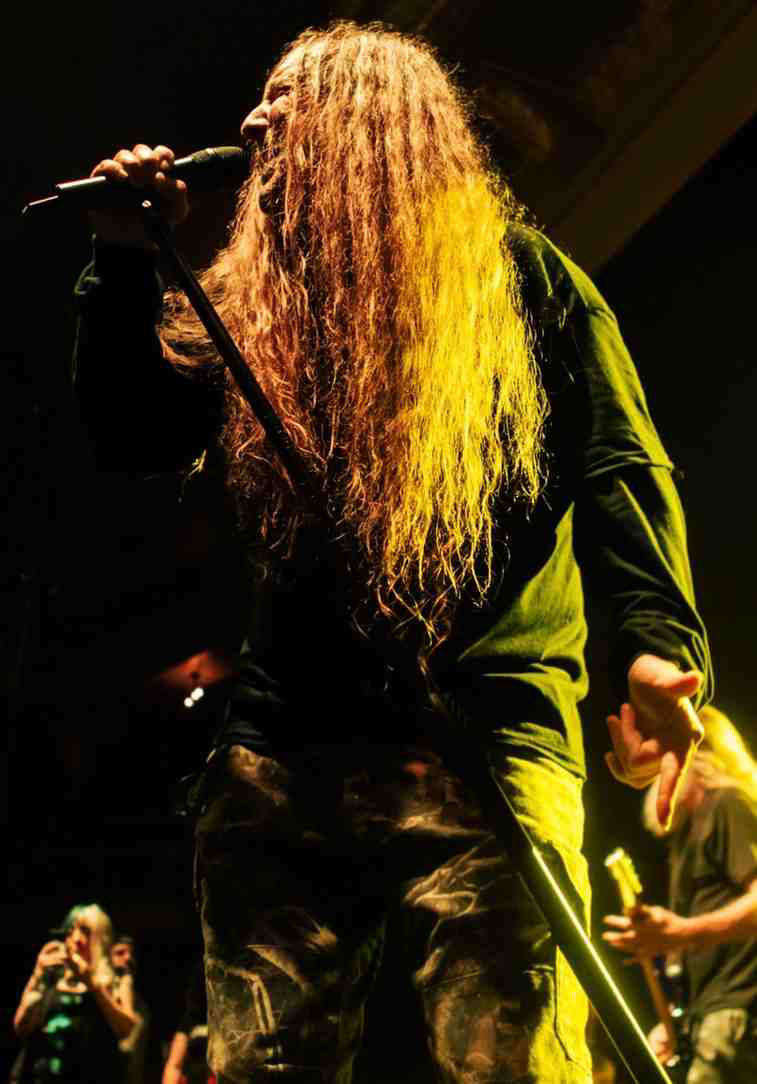
More than four decades after their formation, the band remains one of the most enduring and respected names in extreme music, and by the time Obituary took the stage, the Eagles Ballroom floor was packed with fans eager to witness one of death metal's most legendary acts. The band's massive riffs and thunderous rhythms immediately transformed the room into a sea of headbanging, with mosh pits erupting throughout the crowd. John Tardy's signature vocals sounded as menacing as ever, while the band's veteran presence demonstrated why Obituary has remained a pillar of death metal for generations.
The final band to take the stage before the headliner was, of course, Nunslaughter. Formed in Pittsburgh, Pennsylvania, in 1987, the band built their reputation entirely outside of traditional industry pathways, relying instead on constant touring, a massive catalogue of splits and demos, and an uncompromising commitment to raw extreme metal. Led by founding member Don of the Dead, Nunslaughter became a staple of the global underground, known for a sound that strips death metal down to its most abrasive and direct elements, influenced equally by early thrash, punk, and the first wave of black metal.

On stage at The Rave, that same stripped-down ethos defined their set. Nunslaughter delivered a short, fast, and unrelenting performance that emphasised pace and aggression over polish or technical display. Songs blurred into one another with minimal pause, creating a continuous surge of noise that kept the pit active from start to finish. Rather than relying on theatrics or extended crowd interaction, Nunslaughter’s set functioned as a straight execution of their catalogue in its most direct form. The result was one of the more physically intense sets of the night, reinforcing their reputation as a band that prioritises raw impact and endurance over refinement.
By the time Acid Bath closed out the night at The Eagles Ballroom, the atmosphere inside the venue had shifted from thrash intensity to anticipation bordering on disbelief. Formed in 1991 in Houma, Louisiana, Acid Bath emerged from the Gulf Coast underground with a sound that resisted easy categorisation, blending sludge metal, doom, hardcore punk, and unsettling melodic passages into something both abrasive and atmospheric. Across two studio albums, “When the Kite String Pops" (1994) and “Paegan Terrorism Tactics" (1996), the band built a cult following defined as much by their lyrical bleakness and genre fusion as by their unpredictable shifts between crushing heaviness and eerie calm.

Despite disbanding in 1997 following the death of bassist Audie Pitre, their influence continued to grow, with their recordings gaining near-mythic status in underground metal circles.Their headlining set at The Eagles Ballroom reflected that legacy in both scale and reception. From the opening moments, the band leant into contrast: slow, oppressive passages gave way to sudden surges of distortion, with the crowd responding to each shift as if reacquainting themselves with material that had been absent from stages for years.
The pacing of the set was deliberate, allowing heavier sections to linger and expand before snapping into faster, more chaotic transitions. Vocal delivery moved between abrasive intensity and more melodic phrasing, cutting through a dense wall of guitars that filled the room without feeling overly polished or restrained.By the final stretch of the set, Acid Bath had effectively transformed The Eagles Ballroom into a slow-moving churn of sound and motion, balancing aggression with an almost hypnotic pacing that set them apart from the more straightforward intensity of earlier acts.
As a headlining performance, it functioned less as a traditional climax and more as a final immersion and a retrospective feeling of seeing such a legendary act in the metal scene.
Milwaukee Metal Fest’s lineup for Friday ultimately reflected the obvious full spectrum of extreme music’s past and present. Across the day, legacy acts, underground staples, and newer interpretations of heaviness shared the same stage, each approaching intensity from a different angle. What tied the bill together was not genre uniformity, but consistency in energy and intent.
Whether rooted in early thrash, Florida death metal, crust punk, doom, or modern experimental metal, each band contributed to a shared atmosphere built on volume, density, and audience engagement. Even the shorter, more stripped-down sets functioned as essential contrasts to the longer, more immersive performances, preventing the night from settling into a single rhythmic or stylistic pattern. By the time the final notes faded, The Rave had effectively served as a cross-section of decades of underground heavy music, condensed into a single day.


